



当前位置:首页 > 智慧商学院 > 解析名案例 > 正文
可持续建筑先锋之作:不断激发灵感 引人流连忘返

▲
Herman Miller事务所拥有悠久的建筑实验传统。该公司的第一家制造工厂在密歇根州泽兰,于1959年根据George Nelson的计划完工。公司第一家海外工厂位于英国巴斯,由Nicholas Grimshaw设计,他开发了一种基于可互换玻璃纤维板的模块化设置。本文图片由Herman Miller档案馆提供。
Herman Miller has a long tradition of architectural experimentation. The company’s first manufacturing facility, in Zeeland, Michigan, was completed in 1959 according to plans by George Nelson. Its first overseas plant, in Bath, England, was designed by Nicholas Grimshaw, who developed a modular setup based on interchangeable fiberglass panels.(Seen here: an Action Office 2 module inside the Bath building. )Courtesy Herman Miller Archives
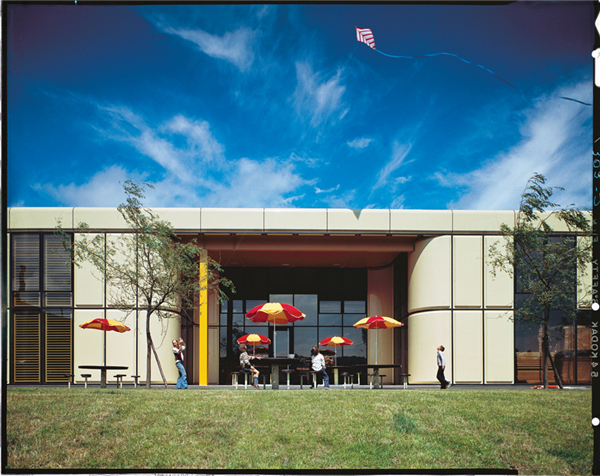
▲ Herman Miller工厂,Grimshaw建筑事务所,英国巴斯,1975年
在20世纪90年代初,美国的绿色建筑产业仍然处于起步阶段,落后于欧洲。就在那时,制造业巨头Herman Miller决定为其子公司SQA(简单,快速,经济实惠)建造一个新工厂。购买和翻新旧办公家具并将其出售给中小型企业的回购计划,SQA发展迅速,并准备独立出去。
In the early 1990s the green-building industry in the United States was still in its infancy, lagging behind Europe. It was then that the manufacturing heavyweight Herman Miller decided to build a new facility for its subsidiary SQA (Simple, Quick, Affordable). A buyback program that purchased and refurbished used office furniture and sold it to small and medium-size businesses, SQA was growing fast and was ready to shed its digs.
制定“重新建设”的战略——并且还要可持续发展——“最好地反映了我们公司的特点”Herman Miller设施管理团队的项目经理Ed Nagelkirk说道,他现在是公司的高级工作场所战略和设施经理。
The strategy to build anew—and do so sustainably—“best reflected the character of our company,” says Ed Nagelkirk, a project manager with the Herman Miller facilities management team at the time of construction and today the company’s senior workplace strategy and facilities manager.
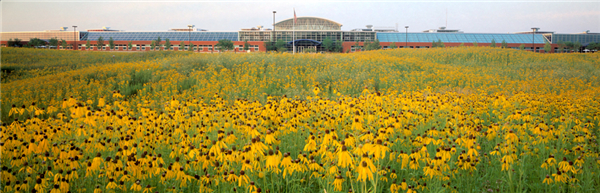
▲ Herman Miller GreenHouse(外观)
这座295,000平方英尺的建筑最终被命名为GreenHouse,于1995年完工,仍然是工作场所和环境设计的里程碑。GreenHouse位于密歇根州荷兰的一个占地37英亩的土地上,其中包括利于为美国绿色建筑委员会(USGBC)LEED认证制定标准的基本要素,包括雨水管理,强大的空气过滤系统,可操作的窗户和66个可以将日光倾泻在生产车间的天窗。
Completed in 1995, the 295,000-square-foot building that would eventually be called the GreenHouse remains a milestone in workplace and environmental design. Set on a 37-acre site in Holland, Michigan, the GreenHouse incorporated elements that helped set the standards for the U.S. Green Building Council’s (USGBC) LEED certification, including stormwater management, a robust air-filtering system, operable windows, and 66 skylights that pour daylight onto the manufacturing floor.
这些和其他创新的实际效果也反映在账面上。GreenHouse每平方英尺仅比公司为类似传统预制建筑支付的费用高10美元——而差异很快被抹平。新工厂在第一年就使SQA的能源账单减少了35,000美元。此外,在开业后的五年内,生产力翻了一番。在这工作的人们很爱这个建筑。“建筑内可以看到天空,”当时一位员工评论道:“没有感觉像被装在盒子里,你都不太觉得自己在工作。”
The practical effects of these and other innovations were also reflected in the receipts. The GreenHouse cost just $10 per square foot more than what the commpany had paid for similar conventional pre-engineered buildings—and the difference was recovered quickly. The new plant slashed $35,000 from SQA’s energy bill in its first year. Moreover, within five years of its opening, productivity doubled. The people working inside the building loved it. “You can see the sky,” one employee commented at the time. “You don’t feel boxed in. And you don’t really feel like you’re at work.”

▲ Herman Miller GreenHouse(内部)
该项目与美国绿色建筑委员会(USGBC)的LEED标准的发展紧密相关,正如公司新专著《Herman Miller:A Way of Living》中自豪地指出的那样。Herman Miller事务所于1992年加入了羽翼未丰的USGBC——这是第二家开发绿色建筑的公司——其中几名员工都是会员。“我们并没有试图引领绿色环保的浪潮,”Nagelkirk回忆道。“我们那时趁着浪潮,试图对制定出LEED这样的标准起到帮助。当我们开始这个项目时,根本还没有LEED。“
The project unfolded in near lockstep with the development of USGBC’s LEED standards, as is proudly pointed out in the company’s new monograph Herman Miller: A Way of Living (Phaidon). Herman Miller had joined the fledgling USGBC in 1992—only the second corporation to do so—and several of its employees were members. “We weren’t trying to ride the green wave,” recalls Nagelkirk. “We were driving that wave, trying to help set the standards that would become LEED. There was no such thing as LEED when we started the project.”
到1993年,随着对选址和工作场所的到位预测,该公司求助于一位名不见经传的纽约建筑师William McDonough,他很快就会因Herman Miller委员会而冉冉升起。Herman Miller的企业档案管理员Amy Auscherman说:“如果你看看我们的历史就会知道,我们一直在寻找创新的机会,无论是制造椅子的方式,还是成为更好的环境管理者。”Herman Miller的企业档案管理员Amy Auscherman说道: “在一位年轻设计师身上冒险非常符合Herman Miller的传统。”
By 1993, with site selection and workplace projections in place, the company turned to a little-known New York architect named William McDonough, whose star would soon rise in part because of the Herman Miller commission. “If you look at our history, we’ve always looked for opportunities to innovate, whether in the way a chair is manufactured, or in becoming even better stewards of the environment,” says Herman Miller’s corporate archivist Amy Auscherman. “And taking a risk on a young designer is very much in the Herman Miller tradition.”
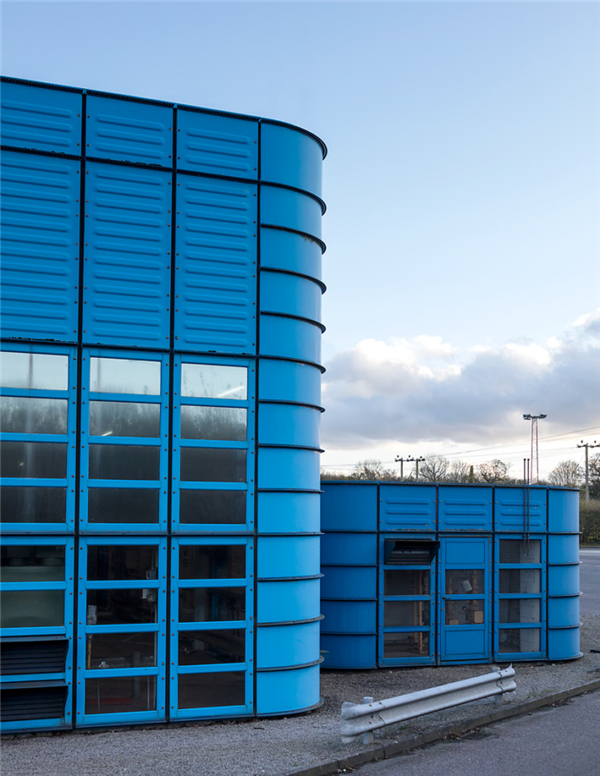
▲ Herman Miller “Blue Building”, Grimshaw建筑事务所, 英国奇彭纳姆, 1982年
几十年来公司的名单上活跃的建筑师证明了这一点。Nicholas Grimshaw当时是一位年轻的英国建筑师,没有几栋建筑是由他设计的,他于1975年完成了Herman Miller在英国巴斯(Bath)的第一家海外工厂,随后又在奇彭纳姆(Chippenham)开设了另一家工厂。职业中期Frank Gehry远非默默无闻,但也不是什么巨星,他于1989年和1991年设计了两家工厂,都在加利福尼亚州。
The roster of spry architects the company retained over the decades bears this point out. Nicholas Grimshaw, then a young British architect with few buildings to his name, completed Herman Miller’s first overseas plant in Bath, England, in 1975, which was later followed by another in Chippenham. A mid-career Frank Gehry, far from obscure yet still a few years from megastardom, designed two facilities in 1989 and 1991, both in California.
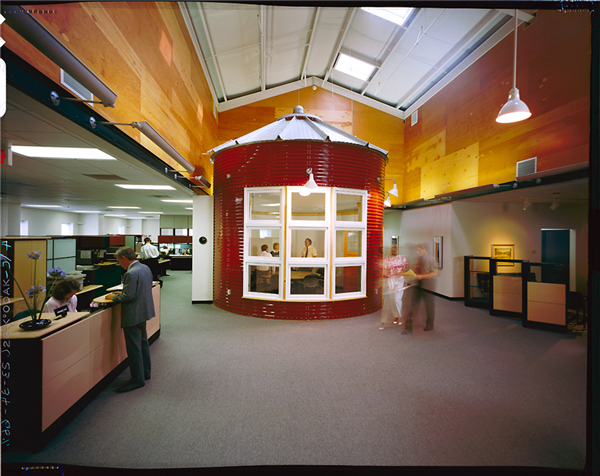
▲ Herman Miller设计楼内部,荷兰,密歇根,1989
即使是像洛杉矶建筑师A. Quincy Jones这样经验丰富的从业者,也主要是因为他的中世纪房屋而闻名,他利用Herman Miller的委托来展示他的设计能力,1970年为公司的荷兰总部起草总体规划,并为基地设计了几栋大型建筑。
Even a seasoned practitioner like the Los Angeles architect A. Quincy Jones, known mostly for his midcentury houses, parlayed a commission from Herman Miller to flex his design muscles, drafting a master plan for the company’s Holland headquarters in 1970 and designing several large buildings for the site.
McDonough本人对Herman Miller并不陌生。公司总裁兼首席执行官J. Kermit Campbell聘请他来设计他在密歇根的家。但GreenHouse要复杂得多,需要系统化的思维方式。1993年初,麦克唐纳参观了将要建造该工厂的连绵起伏的草原。“Bill和我们的领导团队之间一拍即合”Nagelkirk说:“我们知道我们有一个项目。在他和我们待在一起的第一天结束时,比尔已经准备好将他的想法展示给Kerm Campbell,并说服他。“(McDonough雄心勃勃的愿望并非全都呈现在最终的项目上。比如他想要建造一个巨大的绿色屋顶——那可能是密歇根首创——没能实现。)
McDonough himself was no stranger to Herman Miller. Company president and CEO J. Kermit Campbell had hired him to design his Michigan home. But the GreenHouse was much more complex, requiring a systemic type of thinking. In early 1993 McDonough visited the rolling prairie site on which the plant was to be built. “There was an immediate click between Bill and our leadership team,” says Nagelkirk. “We knew we had a project. At the end of his first day with us, Bill was ready to take his ideas to Kerm Campbell and sell him on them.” (Not everything on McDonough’s ambitious wish list made it into the final project. His idea for a sprawling green roof—which would have been perhaps Michigan’s first— was discarded.)
自GreenHouse开始运营以来,它已获得多项可持续发展奖项——在其建造时几乎还没设立的奖项——包括总统环境挑战和保护奖,以及LEED先锋奖。设计杂志和研究生仍然书写着它; 许多人为此前往密歇根州,亲身体验这座建筑。当这些游客离开时,他们会带上一罐蜜蜂后代酿的蜂蜜,这是一种环境友好的方式来驱散纸蜂的侵扰。
Since the GreenHouse’s opening, it has earned several sustainability awards—virtually nonexistent at the time it was constructed—including the President’s Environmental Challenge and Conservation Award, and a LEED Pioneer Award. Design magazines and graduate students still write about the building; many make the pilgrimage to Michigan to experience the building firsthand. When these visitors leave, they do so with a jar of honey, produced by the descendants of bees that were introduced as an environmentally friendly means to disperse an infestation of paper wasps.
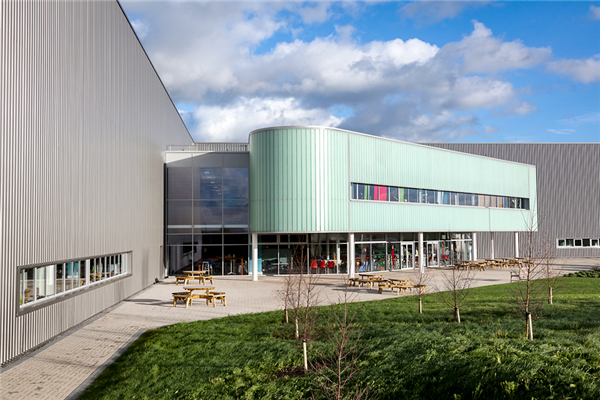
▲ Herman Miller PortalMill工厂,Grimshaw建筑事务所,Melksham,英格兰,2015年
在许多方面,今天的GreenHouse与其说是模型,不如说是纪念碑。LEED标准和可持续设计已经不仅仅只是现在常见的元素,例如绿色屋顶,获得新鲜空气和日光的通道。Herman Miller位于英国Melksham的PortalMill工厂由Grimshaw设计,于2015年完工,具有半透明的玻璃表面和可拆卸的立面系统,可实现外部面板和窗户的互换,这些特性都可以改善GreenHouse的各个方面。在20世纪90年代,当该设施仍然存放SQA的库存时,与建筑师合作的公司规划人员认为其大量的瓦楞纸库存会抑制工厂车间的噪音; 在建筑的用途改变后,混凝土地板下面没有任何隔离屏障。
In many ways, the GreenHouse today is more monument than model. LEED standards and sustainable design have evolved beyond now-commonplace elements such as green roofs and access to fresh air and daylight. Herman Miller’s Portal Mill factory in Melksham, England, designed by Grimshaw and completed in 2015, features translucent glass surfaces and a demountable facade system that enables the interchange of external panels and windows—features that improve upon aspects of the GreenHouse. In the 1990s, when the facility still housed SQA’s stock, company planners working with the architects assumed its substantial corrugated inventory would dampen factory floor noise; after the building’s use changed, no vapor barrier remained beneath the concrete floor.
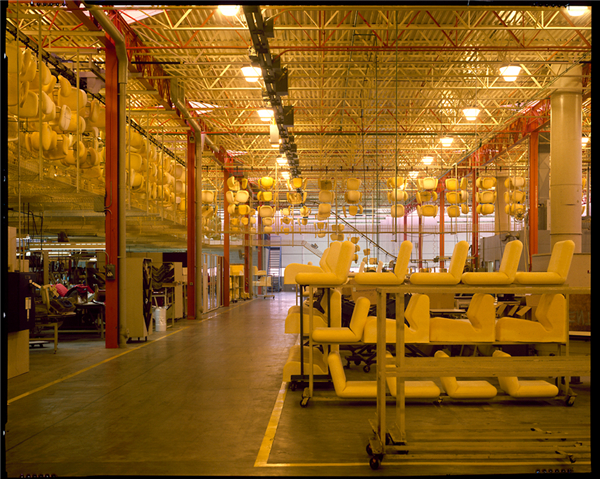
▲ HermanMiller座椅厂(内部),Caudill Rowlett Scott,荷兰,密歇根州,1980年
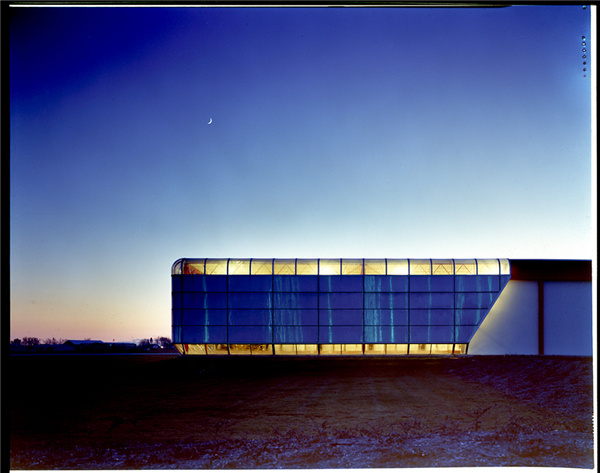
▲ HermanMiller座椅厂(外部),Caudill Rowlett Scott,荷兰,密歇根州,1980年

▲ Vitra(Herman Miller国际合作伙伴)工厂,Grimshaw建筑师事务所,莱茵河畔,德国,1981年
然而,每当Herman Miller的领导谈论调整或扩展他们的荷兰总体规划时,他们从来不会考虑改变GreenHouse。Nagelkirk说:“并不是说我们对此什么都做对了,你没法什么都对。但是我们在这座建筑上做的很多事情,都做的很对。”
And yet, whenever Herman Miller’s leaders talk about adjusting or expanding their Holland master plan, they never consider making changes to the GreenHouse. “It’s not that we got everything right in this building,” says Nagelkirk. “You never get everything right. But we got a heck of a lot right on this one.”
城视窗原创翻译图文专题,转载请联系授权
相关新闻 more>>
>热点推荐
-

- 城视窗专家顾问团队VCR
>热点视频
-
1张磊:做设计与管理的乐之者
- 1
- 张磊:做设计与管理的
点击:1508次
-
2余静赣:空间哲学的诠释者
- 2

- 余静赣:空间哲学的诠
点击:2958次
>热点资讯
- 王受之:大铜钱是广州脸上一道疤
- 莫为崇洋而毁中国建筑大家之根
- HOK副总裁访谈:可持续设计的未来
- 武汉首次对建筑日照定标准
- 他们捧走了“设计的奥斯卡”
- 第22届国际建筑装饰展打造行业盛宴
- 谭盾王澍对谈“音乐、建筑与人生”
- 建筑女魔头扎哈·哈迪德为香港铸就新地标
>城视名片
>名家专栏
>艺术教育

>智慧商学院
网友评论
(共 0条)查看全部